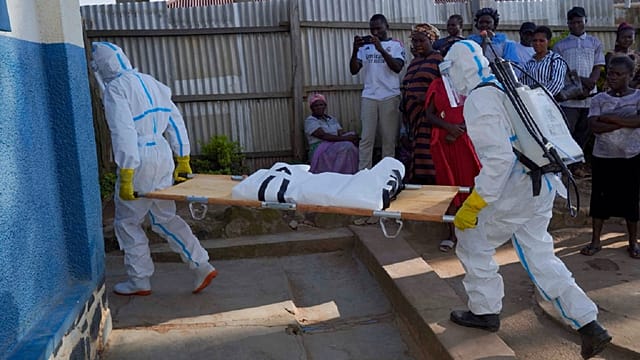
Six months after it was declared, the Ebola outbreak in the Democratic Republic of the Congo is still out of control. In a news release on November 15, the World Health Organization (WHO) named insecurity as one of the “greatest obstacles” to containing it. The Bundibugyo virus has now reached 67 health zones in eight provinces. Government figures reported by Africanews show that nearly half of those infected have died, making this the deadliest of Congo’s 17 Ebola outbreaks.
Violence is taking a heavy toll on the response. A recent armed attack in Cantine-Aloya killed 66 civilians, including three health workers, and three health facilities were looted. In the chaos that followed, more than 1,000 contacts were lost to follow-up, and three confirmed cases are still unaccounted for. The town was attacked again on November 11. The WHO has recorded more than 80 attacks on healthcare since the outbreak began and says a halt in hostilities is “urgently needed”.
Children are among the worst affected. They make up more than a quarter of confirmed cases and one third of deaths, according to the WHO, and seven in 10 children under five with confirmed Ebola have died. UNICEF figures up to November 4 show that children accounted for 35% of deaths. Experts say most children who catch the disease have not received specialised care.
Many infections are found too late. About two-thirds of confirmed deaths happened in communities rather than in treatment centres, and the Africa Centres for Disease Control and Prevention says 80% of new cases are detected outside health surveillance. Health workers have gone on strike several times over pay that is months overdue. Last month the Africa CDC raised concerns about more than $700 million in Ebola aid that remains unaccounted for, while Doctors Without Borders (MSF) described “a troubling disconnect” between the money raised and what actually reaches patients and frontline workers.
The outbreak is concentrated in Ituri and North Kivu, where communities also face armed conflict involving government forces, the Rwanda-backed M23 and the Allied Democratic Forces. Nigeria, Kenya and Uganda have all confirmed cases, making this the most geographically widespread Ebola outbreak on record. Experts say there is little chance of bringing it under control within the next year.
There has been some progress. Transmission has slowed in early hotspots such as Mongbwalu, Nyankunde, Nizi, Rwampara and Butembo. The number of testing laboratories has grown from two to more than two dozen, and nearly 2,000 beds are available in 104 treatment and transit centres. About 3,000 people have recovered. In Nigeria, the NCDC said on November 13 that the index patient, who was evacuated to Switzerland, has recovered, and all 62 of that patient’s contacts completed 21 days of monitoring without any new infection.