
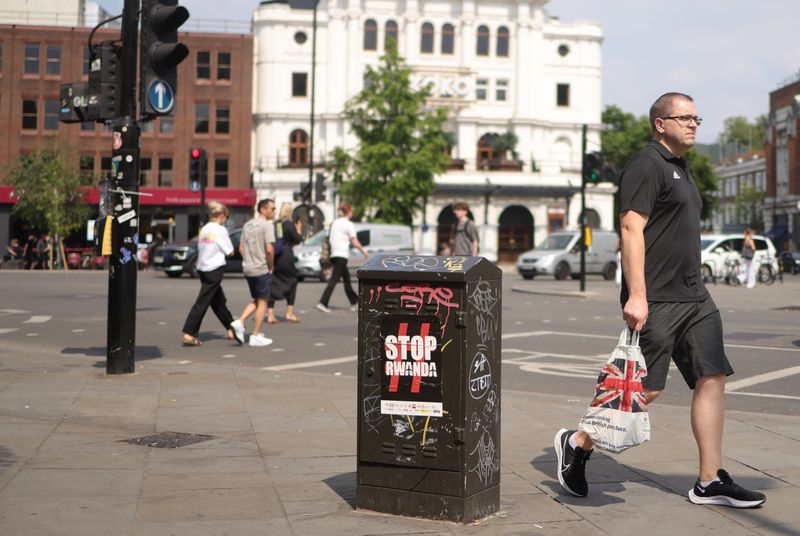


Five EU member states announced plans on Monday to set up an offshore centre in Rwanda for people with no legal right to stay in Europe. Germany, Austria, the Netherlands, Denmark and Greece are the first countries to use the EU’s newly agreed returns law, which speeds up deportations and lets member states set up “return hubs” outside the bloc. The Austrian government described Monday’s step as the start of talks on the scheme.
Diplomatic sources told AFP that the hub would start as a pilot for about 100 people, with each of the five countries possibly sending about 20 migrants. The governments hope to have a centre running in 2027, and the UN’s International Organisation for Migration (IOM) could play a supporting role. An IOM spokesperson said the agency was in talks with some EU countries “on plans for the establishment of return hubs or similar mechanisms”. The scheme covers only migrants who have exhausted every legal avenue to stay in the EU. That sets it apart from Britain’s scrapped plan, which would have sent people to Rwanda while their asylum claims were still being processed.
With elections approaching in several EU countries, governments are under pressure to show they can control migration. Officials backing the hubs say their main purpose is deterrence: migrants who pay smugglers thousands of euros may think twice if they risk ending up in a third country. Critics say there is little evidence for this. Roberto Forin of the Mixed Migration Centre said that enforcement “changes how people travel, not whether they travel”, adding that smugglers adapt and raise their prices.




The five governments say the plan complies with EU and international law, but rights groups are not convinced. The Council of Europe warned in July that return hubs posed “considerable human rights risks”. Céline Mias of the Danish Refugee Council asked what recourse people would have if their rights were violated, and who would be held accountable. Human Rights Watch researcher Clementine de Montjoye said that paying Kigali would “finance and provide political leverage to a government responsible for serious human rights abuses at home and abroad.” The EU Agency for Fundamental Rights said unaccompanied children should not be sent to such hubs.
Rwanda confirmed in August that it had begun “preliminary discussions” with several European states. President Paul Kagame’s government is credited with rebuilding the country after the 1994 genocide, but critics accuse it of suppressing dissent and backing the M23 rebels in the Democratic Republic of Congo. The US began transferring migrants to Rwanda last year. Britain’s Supreme Court ruled the UK plan unlawful in 2023, Labour scrapped it in 2024, and Kigali then sought a £50 million payment.
The European Border and Coast Guard Agency recorded almost 110,000 irregular crossings into the EU in the first 10 months of 2026, down 29% on the previous year. October alone saw about 18,100 crossings, 22% more than in September, driven by a sharp rise in arrivals on the Western African route to the Canary Islands. The new plan is expected to face legal challenges.